Architecture
OpenRoIS maps each concept of RoIS 2.0 onto a process or a class you can deploy. The gateway realizes the main HRI Engine, each adapter realizes a sub HRI Engine, and HRI Components are classes hosted by adapters.
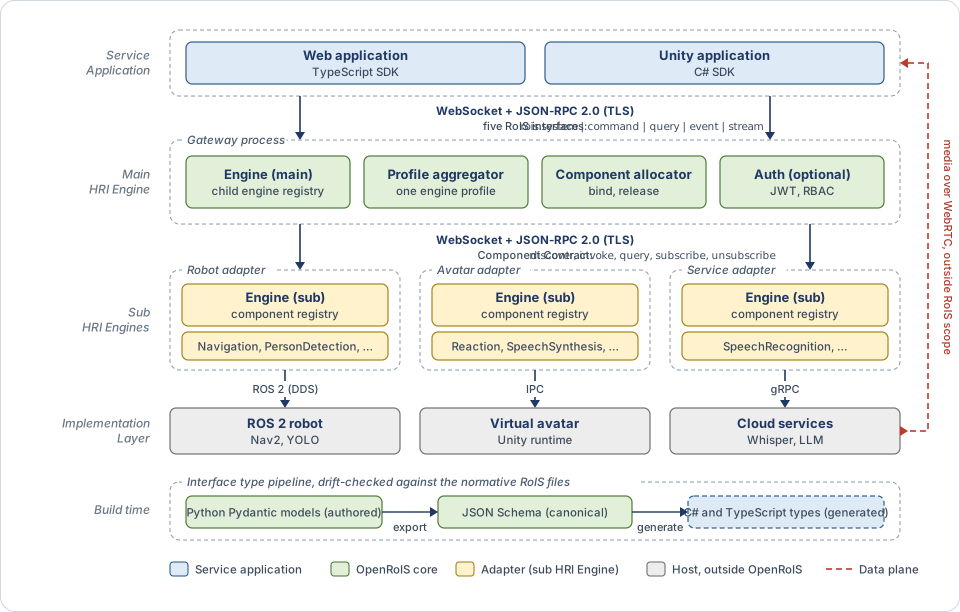
From RoIS Concepts to OpenRoIS
| RoIS concept | OpenRoIS realization |
|---|---|
| Service Application | Your application, built with the TypeScript or C# SDK |
| Main HRI Engine | The gateway: an Engine with child engines, behind a WebSocket server |
| Sub HRI Engine | An adapter: an Engine with local components, connected to the gateway |
| HRI Component | A class decorated with @component, hosted by an adapter |
| RoIS interfaces | JSON-RPC 2.0 methods in the rois.* namespaces |
| Implementation Layer | The robot, avatar, or service behind an adapter, outside OpenRoIS |
The Layers
Service Applications
Applications use a client SDK to connect to the gateway over WebSocket. They discover components from the engine profile, so the same application works with whatever robots, avatars, and services are connected. See writing a service application.
The Gateway
The gateway is the only process that faces the network. It hosts the main HRI Engine, which:
- routes each RoIS call to the adapter that owns the target component,
- aggregates the profiles of all connected adapters into one engine profile,
- allocates actuation components between applications through
bindandrelease, - notifies clients with
rois.system.profile_changedwhen an adapter connects or leaves, so they refresh their view without polling.
Authentication and authorization at the gateway are available and off by default.
Adapters
An adapter is a standalone process that hosts a sub HRI Engine with the components of one platform. It connects to the gateway, answers the gateway's discovery request with its profile, and dispatches incoming calls to its components. Adapters reconnect with exponential backoff if the gateway restarts. See writing components and adapters.
Components
A component is the translation layer between RoIS and one platform. It exposes RoIS
queries, commands, and events, and owns its connection to the platform: a ROS 2 node, a
gRPC client, or a cloud API client, created in connect() and closed in disconnect().
Four Contracts at Four Boundaries
| Boundary | Contract | Transport |
|---|---|---|
| Application to gateway | The five RoIS interfaces | WebSocket, JSON-RPC 2.0 |
| Gateway to adapter | The Component Contract | WebSocket, JSON-RPC 2.0 |
| Adapter to component | Decorated handler methods | In process |
| Component to platform | Whatever the platform requires | ROS 2, gRPC, IPC, HTTP, and others |
Only the first three are middleware boundaries. The last one belongs to the component, and OpenRoIS deliberately takes no position on it.
Build Time: One Source of Truth for Types
The types that cross these boundaries are authored once as Python models and generated into every other language, so the gateway, the adapters, and the SDKs cannot drift apart. See the type pipeline.
Further Reading
- Design principles behind these choices
- The recursive engine that implements both engine roles
- Deployment topologies from one laptop to the internet